
Quotes By Friedrich Nietzsche
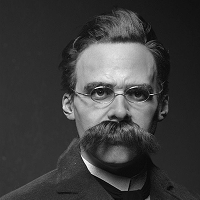
Philosopher
Friedrich Nietzsche
Oct 15, 1844 - Aug 25, 1900
When someone hides something behind a bush and looks for it again in the same place and finds it there as well, there is not much to praise in such seeking and finding. Yet this is how matters stand regarding seeking and finding truth within the realm of reason.

If I make up the definition of a mammal, and then, after inspecting a camel, declare "look, a mammal' I have indeed brought a truth to light in this way, but it is a truth of limited value.
Only by forgetting that he himself is an artistically creating subject, does man live with any repose, security, and consistency. If but for an instant he could escape from the prison walls of this faith, his self consciousness would be immediately destroyed.
It is even a difficult thing for him [humans] to admit to himself that the insect or the bird perceives an entirely different world from the one that man does.
Appearance is a word that contains many temptations, which is why I avoid it as much as possible. For it is not true that the essence of things appears in the empirical world.
A painter without hands who wished to express in song the picture before his mind would, by means of this substitution of spheres, still reveal more about the essence of things than does the empirical world.
Even the relationship of a nerve stimulus to the generated image is not a necessary one.
What is a law of nature as such for us? We are not acquainted with it in itself, but only with its effects, which means in its relation to other laws of nature - which, in turn, are known to us only as sums of relations.
All that conformity to law, which impresses us so much in the movement of the stars and in chemical processes, coincides at bottom with those properties which we bring to things. Thus it is we who impress ourselves in this way.
Indeed, it is only by means of the rigid and regular web of concepts that the waking man clearly sees that he is awake; and it is precisely because of this that he sometimes thinks that he must be dreaming when this web of concepts is torn by art.
Man has an invincible inclination to allow himself to be deceived and is, as it were, enchanted with happiness when the rhapsodist tells him epic fables as if they were true, or when the actor in the theater acts more royally than any real king.
So long as it is able to deceive without injuring, that master of deception, the intellect, is free; it is released from its former slavery and celebrates its Saturnalia. It is never more luxuriant, richer, prouder, more clever and more daring.
There is no regular path which leads from these intuitions into the land of ghostly schemata, the land of abstractions. There exists no word for these intuitions; when man sees them he grows dumb, or else he speaks only in forbidden metaphors and in unheard - of combinations of concepts.
Perhaps no philosopher is more correct than the cynic. The happiness of the animal, that thorough cynic, is the living proof of cynicism.
But what is it that constrains the individual to fear his neighbor, to think and act like a member of a herd, and to have no joy in himself? Modesty, perhaps, in a few rare cases.
Men are even lazier than they are timid, and fear most of all the inconveniences with which unconditional honesty and nakedness would burden them.
Artists alone hate this sluggish promenading in borrowed fashions and appropriated opinions and they reveal everyone's secret bad conscience, the law that every man is a unique miracle.
I will make an attempt to attain freedom, the youthful soul says to itself; and is it to be hindered in this by the fact that two nations happen to hate and fight one another, or that two continents are separated by an ocean, or that all around it a religion is taught with did not yet exist a couple of thousand years ago. All that is not you, it says to itself.
I always believed that at some time fate would take from me the terrible effort and duty of educating myself. I believed that, when the time came, I would discover a philosopher to educate me, a true philosopher whom one could follow without any misgiving because one would have more faith in him than one had in oneself.
But where do we discover a harmonious whole at all, a simultaneous sounding of many voice in one nature, if not in such men as Cellini, men in whom everything, knowledge, desire, love, hate, strives towards a central point, a root force, and where a harmonious system is constructed through the compelling domination of this living centre?
Popular Authors


