
Quotes By Friedrich Nietzsche
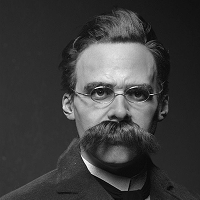
Philosopher
Friedrich Nietzsche
Oct 15, 1844 - Aug 25, 1900
During the longest period of the human past nothing was more terrible than to feel that one stood by oneself. To be alone, to experience things by oneself, neither to obey nor to rule, to be an individual-that was not a pleasure but a punishment; one was sentenced to individuality.

One man adheres to an opinion because he prides himself on having come upon it by himself; another because he has learned it with effort, and is proud of having grasped it: thus both out of vanity.
Myth, the necessary prerequisite of any religion, is already paralyzed everywhere, and even in this domain the optimistic spirit, which we have just designated as the germ of destruction in our society, has attained the mastery.
The noble man does not sin, the profound poet wishes to tell us: through his actions every law, every natural order, the whole moral world can be destroyed, and through the actions a higher magic circle of effects is drawn, founding a new world on the ruin of the old, now destroyed.
The extraordinary courage and wisdom of Kant and Schopenhauer have succeeded in gaining the most difficult victory, the victory over the optimism concealed in the essence of logic-an optimism that is the basis of our culture.
Transform Beethoven's 'Hymn to Joy' into a painting; let your imagination conceive the multitudes bowing to the dust, awestruck-then you will approach the Dionysian.
He does not wear a twitching, mobile, human face, but rather a mask, as it were, with its features in dignified equilibrium; he does not shout, nor does he even change his tone of voice. If a veritable storm-cloud empties itself on his head, he wraps himself in his cloak and slowly walks away from under it.
He shall be the greatest who can be the most solitary, the most concealed, the most divergent, the man beyond good and evil, the master of his virtues, the superabundant of will; this shall be called greatness: the ability to be as manifold as whole, as vast as full.' And, to ask it again: is greatness - possible today?
Perhaps the entire evolution of the spirit is a question of the body; it is the history of the development of a higher body that emerges into our sensibility.
No deed gets undone because it is regretted, no more than because it is forgiven or atoned for.
Men of profound sadness betray themselves when they are happy: they have a way of embracing happiness as if they wanted to crush and suffocate it, from jealousy: alas, they know only too well that it will flee.
Be robbers and ravagers as long as you cannot be rulers and owners, you men of knowledge! The time will soon be past when you could be content to live concealed in the woods like timid deer!
Popular Authors


