
Quotes By Friedrich Nietzsche
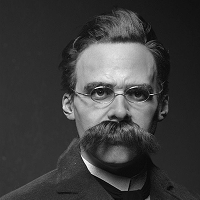
Philosopher
Friedrich Nietzsche
Oct 15, 1844 - Aug 25, 1900
The highest type of free men should be sought where the highest resistance is constantly overcome: five steps from tyranny, close to the threshold of the danger of servitude.

Man must be sustained in suffering by a hope so high that no conflict with actuality can dash it-so high, indeed, that no fulfilment can satisfy it: a hope reaching out beyond this world.
Do I still have to add that in the entire New Testament there is only one solitary figure one is obliged to respect? Pilate, the Roman governor. To take a Jewish affair seriously - he cannot persuade himself to do that.
The God that Paul invented for himself, a God who reduced to absurdity the wisdom of this world (especially the two great enemies of superstition, philology and medicine), is in truth only an indication of Paul's resolute determination to accomplish that very thing himself: to give one's own will the name of God, Torah - that is essentially Jewish.
Whom do I hate most among the rabble of today? The socialist rabble, the chandala apostles, who undermine the instinct, the pleasure, the worker's sense of satisfaction with his small existence-who make him envious, who teach him revenge. The source of wrong is never unequal rights but the claim of equal rights.
Christianity destroyed for us the whole harvest of ancient civilization, and later it also destroyed for us the whole harvest of Mohammedan civilization. The wonderful culture of the Moors in Spain, which was fundamentally nearer to us and appealed more to our senses and tastes than that of Rome and Greece, was trampled down.
Intrinsically there should be no more choice between Islam and Christianity than there is between an Arab and a Jew. The decision is already reached; nobody remains at liberty to choose here.
All things considered, I could never have survived my youth without Wagnerian music. For I seemed condemned to the society of Germans. If a man wishes to rid himself of a feeling of unbearable oppression, he may have to take to hashish. Well, I had to take to Wagner.
In my opinion, Henrik Ibsen has become very German. With all his robust idealism and "Will to Truth," he never dared to ring himself free from moral-illusionism which says "freedom," and will not admit, even to itself, what freedom is: the second stage in the metamorphosis of the "Will to Power" in him who lacks it.
Help thyself: then everyone will help thee too. Principle of Christian charity.
To regard states of distress in general as an objection, as something which must be abolished is the greatest nonsense on earth; having the most disastrous consequences, fatally stupid - almost as stupid as a wish to abolish bad weather - out of pity for the poor.
We are doubly willing to jump into the water after some one who has fallen in, if there are people present who have not the courage to do so.
In the stream - mighty waters draw much stone and rubble along with them; mighty spirits many stupid and bewildered heads.
This sign I give you: every people speaks its tongue of good and evil, which the neighbor does not understand. It has invented its own language of customs and rights.
It is our needs that interpret the world; our drives and their For and Against. Every drive is a kind of lust to rule; each one has its perspective that it would like to compel all other drives to accept as a norm.
My brother, are war and battle evil? Necessary, however, is the evil; necessary are the envy and the distrust and the back-biting among the virtues.
Their usual mistaken premise is that they affirm some consensus among people, at least among tame peoples, concerning certain moral principles, and then conclude that these principles must be unconditionally binding also for you and me-or conversely, they see that among different peoples moral valuations are necessarily different and infer from this that no morality is binding-both of which are equally childish.
Every kind of perfection is purchased at a high price on earth, where everything is perhaps purchased too dear; one is an expert in one's department at the price of being also a victim of one's department.
For in one's heart one loveth only one's child and one's work; and where there is great love to oneself, then is it the sign of pregnancy: so have I found it.
Popular Authors


