
Quotes By Friedrich Nietzsche
Philosopher
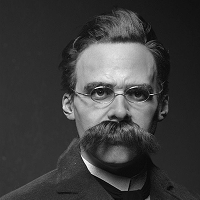
Friedrich Nietzsche
Oct 15, 1844 - Aug 25, 1900
What can it matter to us what tinsel the sick may use to cover up their weakness? Let them parade it as their virtue; after all, there is no doubt that weakness makes one mild, oh so mild, so righteous, so inoffensive, so humane!

I welcome all signs that a more virile, warlike age is about to begin, which will restore honor to courage above all! For this age shall prepare the way for one yet higher, and it shall gather the strength that this higher age will require some day.
To this end we now need many preparatory courageous human beings who cannot very well leap out of nothing - any more than out of the sand and slime of present-day civilization and metropolitanism: human beings who know how to be silent, lonely, resolute, and content and constant in invisible activities.
Everything the State says is a lie, and everything it has it has stolen.
They are not clean enough for me, either: they all disturb their waters so that they may seem deep.
There still shines the most important nuance by virtue of which the noble felt themselves to be men of a higher rank. They designate themselves simply by their superiority in power or by the most clearly visible signs of this superiority, for example, as the rich, the possessors.
As is well known, the priests are the most evil enemies - but why? Because they are the most impotent. It is because of their impotence that in them hatred grows to monstrous and uncanny proportions, to the most spiritual and poisonous kind of hatred.
The truly great haters in the world history have always been priests; likewise the most ingenious haters: other kinds of spirit hardly come into consideration when compared with the spirit of priestly vengefulness.
While every noble morality develops from a triumphant affirmation of itself, slave morality from the outset says no to what is outside, what is different, what is not itself; and this No is its creative deed.
To be incapable of taking one's enemies, one's accidents, even one's misdeeds seriously for very long-that is the sign of strong, full natures in whom there is an excess of the power to form, to mold, to recuperate and to forget. Such a man shakes off with a single shrug many vermin that eat deep into others.
How much reverence has a noble man for his enemies!-and such reverence is a bridge to love. For he desires his enemy for himself, as his mark of distinction; he can endure no other enemy than one in whom there is nothing to despise and very much to honor!
Let me declare expressly that in the days when mankind was not yet ashamed of its cruelty, life on earth was more cheerful than it is now that pessimists exist.
That every will must consider every other will its equal - would be a principle hostile to life, an agent of the dissolution and destruction of man, an attempt to assassinate the future of man, a sign of weariness, a secret path to nothingness.
Punishment makes men hard and cold; it concentrates; it sharpens the feeling of alienation; it strengthens the power of resistance.
All instincts that do not discharge themselves outwardly turn inward - this is what I call the internalization of man: thus it was that man first developed what was later called his soul.
Ascetic ideals reveal so many bridges to independence that a philosopher is bound to rejoice and clap his hands when he hears the story of all those resolute men who one day said No to all servitude and went into some desert.
Socrates-the malicious Socrates, it would seem, married ironically, just to demonstrate this proposition.
When one gives up Christian belief one thereby deprives oneself of the right to Christian morality. For the latter is absolutely not self-evident: one must make this point clear again and again, in spite of English shallowpates.
How is freedom measured, in individuals as in nations? By the resistance which must be overcome, by the effort [Mühe] it costs to remain on top.
Popular Authors


