
Quotes By Friedrich Nietzsche
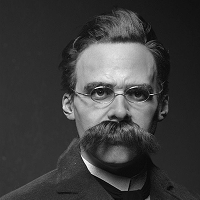
Philosopher
Friedrich Nietzsche
Oct 15, 1844 - Aug 25, 1900
Their [Christian scholars] continual cry is: "I am right, for it is written"-and then follows an explanation so shameless and capricious that a philologist, when he hears it, must stand stock-still between anger and laughter, asking himself again and again: Is it possible? Is it honest? Is it even decent?

It is only those who never-or always-attend church that underestimate the dishonesty with which this subject is still dealt in Protestant pulpits; in what a clumsy fashion the preacher takes advantage of his security from interruption; how the Bible is pinched and squeezed; and how the people are made acquainted with every form of the art of false reading.
He who lives as children live - who does not struggle for his bread and does not believe that his actions possess any ultimate significance - remains childlike.
He who is punished is never he who performed the deed. He is always the scapegoat.
Each man should speak his mind, even if everything were to be turned upside down. This point, however, is open to dispute.
The truth must be told, even if the world should be shivered in fragments.
I do not want to believe it although it is palpable: the great majority of people lack an intellectual conscience. Indeed, it has often seemed to me as if anyone calling for an intellectual conscience were as lonely in the most densely populated cities as if he were in a desert.
The great majority of people does not consider it contemptible to believe this or that and to live accordingly, without first having given themselves an account of the final and most certain reasons pro and con, and without even troubling themselves about such reasons afterward: the most gifted men and the noblest women still belong to this great majority.
We are, all of us, growing volcanoes that approach the hour of their eruption; but how near or distant that is, nobody knows - not even God.
To find everything profound - that is an inconvenient trait. It makes one strain one's eyes all the time, and in the end one finds more than one might have wished.
The most perfidious way of harming a cause consists of defending it deliberately with faulty arguments.
Virtue gives happiness and a state of blessedness only to those who have a strong faith in their virtue. Not, however, to the more refined souls whose virtue consists of a profound distrust of themselves and of all virtue. After all, therefore, it is faith that saves here also!
Whatever has value in our world now does not have value in itself, according to its nature - nature is always value-less, but has been given value at some time, as a present - and it was we who gave and bestowed it.
I want to have my lion and my eagle about me, that I may always have hints and premonitions concerning the amount of my strength or weakness. Must I look down on them today, and be afraid of them? And will the hour come once more when they will look up to me, and tremble?
One sees that science also rests on a belief: there is no science at all without premises.
The question whether truth is necessary, must not merely be affirmed beforehand, but must be affirmed to such an extent that the principle, belief, or conviction finds expression, that there is nothing more necessary than truth, and in comparison with it everything else has only a secondary value.
We conserve nothing; neither do we want to return to any past periods; we are not by any means liberal; we do not work for progress; we do not need to plug up our ears against the sirens who in the market place sing of the future: their song about equal rights, a free society, no more masters and no servants has no allure for us.
We are delighted with all who love, as we do, danger, war, and adventures, who refuse to compromise, to be captured, reconciled, and castrated.
We count ourselves among conquerors; we think about the necessity for new orders, also for a new slavery - for every strengthening and enhancement of the human type also involves a new kind of enslavement.
Popular Authors


