
Quotes By Friedrich Nietzsche
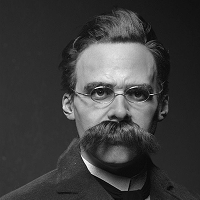
Philosopher
Friedrich Nietzsche
Oct 15, 1844 - Aug 25, 1900
That educating philosopher of whom I dreamed would, I came to think, not only discover the central force, he would also know how to prevent its acting destructively on the other forces: his educational task would, it seemed to me, be to mould the whole man into a living solar and planetary system and to understand its higher laws of motion.

The civilized classes and nations are swept away by the grand rush for contemptible wealth. Never was the world worldlier, never was it emptier of love and goodness.
All that exists that can be denied deserves to be denied; and being truthful means: to believe in an existence that can in no way be denied and which is itself true and without falsehood.
The objective of all human arrangements is through distracting one's thoughts to cease to be aware of life.
It is the misfortune of active men that their activity is almost always a bit irrational. For example, one must not inquire of the money-gathering banker what the purpose for his restless activity is: it is irrational. Active people roll like a stone, conforming to the stupidity of mechanics.
However far man may extend himself with his knowledge, however objective he may appear to himself - ultimately he reaps nothing but his own biography.
The distinction that lies in being unhappy (as if to feel happy were a sign of shallowness, lack of ambition, ordinariness) is so great that when someone says, "But how happy you must be!" we usually protest.
He who wants to set a good example must add a grain of foolishness to his virtue; then others can imitate and, at the same time, rise above the one being imitated - something which people love.
Everyone has his good day, when he finds his higher self; and true humanity demands that we judge someone only when he is in this condition, and not in his workdays of bondage and servitude.
Some regard their ideal with shy humility and would like to deny it: they fear their higher self because, when it speaks, it speaks demandingly.
Essentially, we are still the same people as those in the period of the Reformation - and how should it be otherwise? But we no longer allow ourselves certain means to gain victory for our opinion: this distinguishes us from that age and proves that we belong to a higher culture.
These days, if a man still attacks and crushes opinions with suspicions and outbursts of rage, in the manner of men during the Reformation, he clearly betrays that he would have burnt his opponents, had he lived in other times, and that he would have taken recourse to all the means of the Inquisition, had he lived as an opponent of the Reformation.
The fervor about having the truth counts very little today in relation to that other fervor, more gentle and silent, to be sure, for seeking the truth, a search that does not tire of learning afresh and testing anew.
Who is the most moral man? First, he who obeys the law most frequently, who ... is continually inventive in creating opportunities for obeying the law. Then, he who obeys it even in the most difficult cases. The most moral man is he who sacrifices the most to custom.
Self-overcoming is demanded, not on account of any useful consequences it may have for the individual, but so that hegemony of custom and tradition shall be made evident.
Whoever has overthrown an existing law of custom has hitherto always first been accounted a bad man: but when, as did happen, the law could not afterwards be reinstated, and this fact was accepted, the predicate gradually changed. History treats almost exclusively of these bad men who subsequently became good men!
Perhaps nothing is more fatiguing than the sight of a continual conqueror.
We, who know only the melancholy of ruins, can scarcely understand that totally different melancholy of eternal buildings, from which men endeavoured to save themselves as best they could.
This mute, century-old hatred of the wearied spectators against Rome, wherever Rome's domination extended, was at length vented in Christianity, which united Rome, the world, and sin into a single conception.
How little Christianity cultivates the sense of honesty can be inferred from the character of the writings of its learned men. They set out their conjectures as audaciously as if they were dogmas, and are but seldom at a disadvantage in regard to the interpretation of Scripture.
Popular Authors


