
Quotes By Friedrich Nietzsche
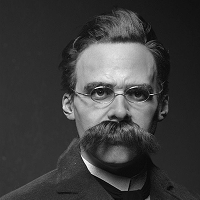
Philosopher
Friedrich Nietzsche
Oct 15, 1844 - Aug 25, 1900
This independence is glorified as academic freedom, ... except that in the background, a discreet distance away, stands the state watching with a certain supervisory look on its face, making sure to remind everybody from time to time that it is the aim, the purpose, the essence of this whole strange process.

Philological considerations have slowly but surely taken the place of profound explorations of eternal problems. The question becomes: What did this or that philosopher think or not think? And is this or that text rightly ascribed to him or not?
Not one of these nobly equipped young men has escaped the restless, exhausting, confusing, debilitating crisis of education. He feels that he cannot guide himself, cannot help himself-and then he dives hopelessly into the world of everyday life and daily routine, he is immersed in the most trivial activity possible, and his limbs grow weak and weary.
Only by means of such discipline can the young man acquire that physical loathing for the beloved and much-admired elegance of style of our newspaper manufacturers and novelists, and for the ornate style of our literary men.
Everybody who is in earnest in this matter will have the same sort of experience as the recruit in the army who is compelled to learn walking after having walked almost all his life as a dilettante or empiricist. It is a hard time: one almost fears that the tendons are going to snap and one ceases to hope that the artificial and consciously acquired movements and positions of the feet will ever be carried out with ease and comfort.
It is painful to see how awkwardly and heavily one foot is set before the other, and one dreads that one may not only be unable to learn the new way of walking, but that one will forget how to walk at all.
Culture begins, however, with the correct movement of the language: and once it has properly begun, it begets that physical sensation in the presence of 'elegant' writers which is known by the name of 'loathing.'
Once upon a time, in some out of the way corner of that universe which is dispersed into numberless twinkling solar systems, there was a star upon which clever beasts invented knowing.
After nature had drawn a few breaths, the star cooled and congealed, and the clever beasts had to die. One might invent such a fable, and yet he still would not have adequately illustrated how miserable, how shadowy and transient, how aimless and arbitrary the human intellect looks within nature.
The pride connected with knowing and sensing lies like a blinding fog over the eyes and senses of men, thus deceiving them concerning the value of existence.
They [humans] are deeply immersed in illusions and in dream images; their eyes merely glide over the surface of things and see "forms."
What does man actually know about himself? Is he, indeed, ever able to perceive himself completely, as if laid out in a lighted display case?
Does nature not conceal most things from him - even concerning his own body - in order to confine and lock him within a proud, deceptive consciousness, aloof from the coils of the bowels, the rapid flow of the blood stream, and the intricate quivering of the fibers!
Woe betide fateful curiosity should it ever succeed in peering through a crack in the chamber of consciousness.
The liar is a person who uses the valid designations, the words, in order to make something which is unreal appear to be real. He says, for example, "I am rich," when the proper designation for his condition would be "poor."
What men avoid by excluding the liar is not so much being defrauded as it is being harmed by means of fraud.
Every concept arises from the equation of unequal things. Just as it is certain that one leaf is never totally the same as another, so it is certain that the concept "leaf" is formed by arbitrarily discarding these individual differences and by forgetting the distinguishing aspects.
As a rational being, he now places his behavior under the control of abstractions. He will no longer tolerate being carried away by sudden impressions, by intuitions.
Everything which distinguishes man from the animals depends upon this ability to volatilize perceptual metaphors in a schema, and thus to dissolve an image into a concept.
One may certainly admire man as a mighty genius of construction, who succeeds in piling an infinitely complicated dome of concepts upon an unstable foundation, and, as it were, on running water.
Popular Authors


