
Quotes By Friedrich Nietzsche
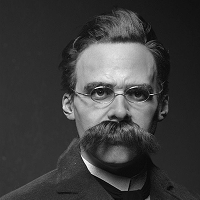
Philosopher
Friedrich Nietzsche
Oct 15, 1844 - Aug 25, 1900
Hope, in its stronger forms, is a great deal more powerful stimulans to life than any sort of realized joy can ever be.

I climb upon the highest mountains, laughing at all tragedies - whether real or imaginary.
You may have enemies whom you hate, but not enemies whom you despise. You must be proud of your enemy: then the success of your enemy shall be your success too.
A very popular error: having the courage of one's convictions; rather it is a matter of having the courage for an attack on one's convictions.
Profundity of thought belongs to youth, clarity of thought to old age.
We are unknown to ourselves, we men of knowledge-and with good reason. We have never sought ourselves-how could it happen that we should ever find ourselves? It has rightly been said: Where your treasure is, there will your heart be also.
I want to teach men the sense of their existence, which is the Superman, the lightning out of the dark cloud man.
There is such a thing as a hatred of lies and dissimulation, which is the outcome of a delicate sense of humor; there is also the selfsame hatred but as the result of cowardice, in so far as falsehood is forbidden by Divine law. Too cowardly to lie.
That little hypocrites and half-crazed people dare to imagine that on their account the laws of nature are constantly broken; such an enhancement of every kind of selfishness to infinity, to impudence, cannot be branded with sufficient contempt. And yet Christianity owes its triumph to this pitiable flattery of personal vanity.
For the purpose of knowledge we must know how to make use of the inward current which draws us towards a thing, and also of the current which after a time draws us away from it.
A man who wills, commands something within himself that renders obedience, or that he believes renders obedience.
He who strays from the customary becomes a sacrifice to the extraordinary; he who keeps to the customary becomes its slave. He is condemned to perish in either case.
If we lacked curiosity, we should do less for the good of our neighbor. But, under the name of duty or pity, curiosity steals into the home of the unhappy and the needy. Perhaps even in the famous mother-love there is a good deal of curiosity.
Spirit is the life that itself cuts into life: with its own torment it increases its own knowledge. Did you already know that?
One is fruitful only at the cost of being rich in contradictions.
On all the walls, wherever walls exist, I will inscribe this eternal indictment of Christianity-I have letters to make even blindmen see.... I call Christianity the single great curse, the single great innermost depravity, the single great instinct of revenge, for which no means is poisonous, secretive, subterranean, small enough-I call it mankind's single immortal blemish.... And we reckon time from the dies nefastus with which this calamity arose-following Christianity's first day!-Why not following its last day, instead?-Following today?-Transvaluation of all values!
A refined soul is distressed to know that someone owes it thanks; a crude soul, to know that it owes someone thanks.
Through searching out origins, one becomes a crab. The historian looks backwards, and finally he also believes backwards.
To those human beings who are of any concern to me I wish suffering, desolation, sickness, ill-treatment, indignities-I wish that they should not remain unfamiliar with profound self-contempt, the torture of self-mistrust, the wretchedness of the vanquished: I have no pity for them, because I wish them the only thing that can prove today whether one is worth anything or not-that one endures.
The noble type of man feels himself to be the determiner of values, he does not need to be approved of, he judges 'what harms me is harmful in itself', he knows himself to be that which in general accords honour to things, he creates values.
Popular Authors


