
Quotes By Friedrich Nietzsche
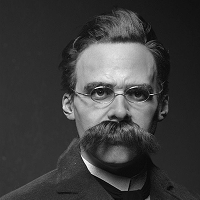
Philosopher
Friedrich Nietzsche
Oct 15, 1844 - Aug 25, 1900
Without myth, however, every culture loses its healthy creative natural power: it is only a horizon encompassed with myth that rounds off to unity a social movement.

What the sense feeleth, what the spirit discerneth, hath never its end in itself. But sense and spirit would fain persuade thee that they are the end of all things: so vain are they.
At present I am light, now I fly, now I see myself below me, now a god dances through me.
I love him who laboureth and inventeth, that he may build the house for the Superman, and prepare for him earth, animal, and plant: for thus seeketh he his own down-going.
As soon as we are shown the existence of something old in a new thing, we are pacified.
And if ye cannot be saints of knowledge, then, I pray you, be at least its warriors. They are the companions and forerunners of such saintship.
In the beautiful, man sets himself up as the standard of perfection; in select cases he worships himself in it. Man believes that the world itself is filled with beauty-he forgets that it is he who has created it. He alone has bestowed beauty upon the world-alas! only a very human, an all too human, beauty.
There is only a perspective seeing, only a perspective 'knowing'; and the more affects we allow to speak about one thing, the more eyes, different eyes, we can use to observe one thing, the more complete will our 'concept' of this thing, our 'objectivity,' be.
Error has made animals into men; is truth in a position to make men into animals again?
One will rarely err if extreme actions be ascribed to vanity, ordinary actions to habit, and mean actions to fear.
No one talks more passionately about his rights than he who in the depths of his soul doubts whether he has any. By enlisting passion on his side he wants to stifle his reason and its doubts: thus he will acquire a good conscience and with it success among his fellow men.
Whatever was in the light, acts in the darkness. What we experience in dreams, so long as we experience it frequently, is in the end just as much a part of the total economy of our soul as anything we "really" experience: because of it we are richer or poorer, are sensitive to one need more or less, and are eventually guided a little by our dream-habits in broad daylight and even in the most cheerful moments occupying our waking spirit.
You want to be paid as well, you virtuous! You want reward for virtue, and heaven for earth, and eternity for your today?
The most vulnerable and yet most unconquerable of things is human vanity; nay, through being wounded its strength increases and can grow to giant proportions.
Man demands truth and fulfills this demand in moral intercourse with other men; this is the basis of all social life. One anticipates the unpleasant consequences of reciprocal lying. From this there arises the duty of truth. We permit epic poets to lie because we expect no detrimental consequences in this case. Thus the lie is permitted where it is considered something pleasant. Assuming that it does no harm, the lie is beautiful and charming.
If you believed more in life you would fling yourself less to the moment.
Does not the discipline of the scientific spirit just commence when one no longer harbours any conviction?
A man unconsciously imagines that where he is strong, where he feels most thoroughly alive, the element of his freedom must lie.
Belief in the truth commences with the doubting of all those truths we once believed.
Popular Authors


