
Quotes By Mark Zuckerberg
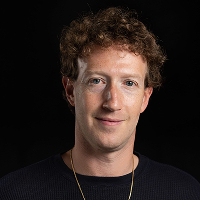
Businessman
Mark Zuckerberg
May 14, 1984 - present
I wear the same outfit or, at least, a different copy of it almost every day.

What we will do is we'll say, 'Okay, you have your page, and if you're not trying to organize harm against someone, or attacking someone, then you can put up that content on your page, even if people might disagree with it or find it offensive.' But that doesn't mean that we have a responsibility to make it widely distributed in News Feed.
I always kind of see how I want things to be better, and I'm generally not happy with how things are or the level of service that we're providing for people or the quality of the teams that we built. But if you look at this objectively, we're doing so well on so many of these things. I think it's important to have gratitude for that.
We just think that there are all these different ways that people want to share, and that compressing them all into a single blue app is not the right format of the future.
One of my big regrets is that Facebook hasn't had a major chance to shape the mobile operating system ecosystem.
I feel like the thing we can do is celebrate people doing great work and create more cultural momentum and awareness that this is an important thing in the world. So when the next economic crisis hits and people are talking about where to cut from the budget, science isn't the thing.
We're very focused on making News Feed really good, making our photos experience really good, making messaging really good, and creating great location apps. That's the nature of a platform business of our scale. Most companies that are relevant to us will have some overlaps in some competitive way.
I remember flying in, driving down 101 in a cab, and passing by all these tech companies like Yahoo! I remember thinking, 'Maybe someday we'll build a company. This probably isn't it, but one day we will.'
There are good examples of companies - Coca-Cola is one - that invested before there was a huge market in countries, and I think that ended up playing out to their benefit for decades to come.
Open Graph is a language for structuring content and sharing that goes on in other apps, and we're continuing to build it out longer term. But we found we need to build more specific experiences around categories like music or movies. Where we've taken the time to build those specific experiences, stuff has gone quite well.
We want to make it so that anyone, anywhere - a child growing up in rural India who never had a computer - can go to a store, get a phone, get online, and get access to all of the same things that you and I appreciate about the Internet.
Video is growing very quickly on Facebook. A lot of people compare that to YouTube. I think that kind of makes sense. YouTube isn't the only video service, but I think it's the biggest, and it probably makes more sense to compare Facebook video to YouTube rather than Netflix because that's a completely different kind of content.
After launching the first version of Facebook for a few thousand users, we would discuss how this should be built for the world. It wasn't even a thought that maybe it could be us. We always thought it would be someone else doing it.
Now the playbook is we build AI tools to go find these fake accounts, find coordinated networks of inauthentic activity, and take them down; we make it much harder for anyone to advertise in ways that they shouldn't be.
In retrospect, I do think it's fair to say that we were overly idealistic and focused on more of the good parts of what connecting people and giving people a voice can bring.
As abhorrent as some of this content [holocaust denial] can be, I do think that it gets down to this principle of giving people a voice.
The main Facebook usage is so big. About 20 percent of the time people spend on their phone is on Facebook.
We have these services that people love and that are drivers of data usage... and we want to work this out, so that way, it's a profitable model for our partners.
We're a community of a billion-plus people, and the best-selling phones - apart from the iPhone - can sell 10, 20 million. If we did build a phone, we'd only reach 1 or 2 percent of our users. That doesn't do anything awesome for us. We wanted to turn as many phones as possible into 'Facebook phones.' That's what Facebook Home is.
A frustration I have is that a lot of people increasingly seem to equate an advertising business model with somehow being out of alignment with your customers. I think it's the most ridiculous concept.
Popular Authors


