
Quotes By Friedrich Nietzsche
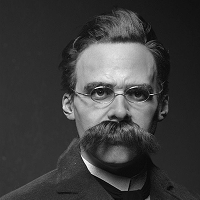
Philosopher
Friedrich Nietzsche
Oct 15, 1844 - Aug 25, 1900
Wherever I found a living creature, there I found the will to power.

Those things for which we find words, are things we have already overcome. In all speech there lies an element of contempt.
There will be but few people who, when at a loss for topics of conversation, will not reveal the more secret affairs of their friends.
What was silent in the father speaks in the son, and often I found in the son the unveiled secret of the father.
Whatever harm the evil may do, the harm done by the good is the most harmful harm.
One should not wrongly reify 'cause' and 'effect,' as the natural scientists do (and whoever, like them, now 'naturalizes' in his thinking), according to the prevailing mechanical doltishness which makes the cause press and push until it 'effects' its end; one should use 'cause' and 'effect' only as pure concepts, that is to say, as conventional fictions for the purpose of designation and communication-not for explanation.
A woman's pity, which is talkative, carries the sick person's bed to the public marketplace.
All signs of superhuman nature appear in man as illness or insanity.
A man of genius is unbearable, unless he possesses at least two things besides: gratitude and purity.
My philosophy is inverted Platonism: the further a thing is from true being, the purer, the lovelier, the better it is. Living in illusion as a goal!
For as long as they praise you, never forget that it is not yet your own path that you walk, but another person's.
For both parties in a controversy, the most disagreeable way of retaliating is to be vexed and silent; for the aggressor usually regards the silence as a sign of contempt.
The man who sees little always sees less than there is to see; the man who hears badly always hears something more than there is to hear.
Every virtue inclines to stupidity, every stupidity to virtue; "stupid to the point of sanctity," they say in Russia.
No man ever wrote more eloquently and luminously [than Heraclitus].
Everyone carries within himself an image of womanliness derived from his mother: it is this that determines whether, on the whole, he will revere women, or despise them, or remain generally indifferent to them.
Popular Authors


