
Quotes By Dalai Lama
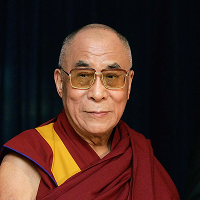
Spiritual Leader
Dalai Lama
Jul 06, 1935 - present
I believe that to meet the challenges of our times, human beings will have to develop a greater sense of universal responsibility. Each of us must learn to work not just for oneself, one's own family, or nation, but for the benefit of all humankind. Universal responsibility is the key to human survival. It is the best foundation for world peace.
When we are motivated by compassion and wisdom, the results of our actions benefit everyone, not just our individual selves or some immediate convenience. When we are able to recognize and forgive ignorant actions of the past, we gain strength to constructively solve the problems of the present.
Hard times build determination and inner strength. Through them, we can also come to appreciate the uselessness of anger. Instead of getting angry, nurture a deep caring and respect for troublemakers because by creating such trying circumstances, they provide us with invaluable opportunities to practice tolerance and patience.
Inner peace is the key. If you have inner peace, the external problems do not affect your deep sense of peace and tranquility. Without this inner peace, no matter how comfortable your life is materially, you may still be worried, disturbed, or unhappy because of circumstances.
Those who have little interest in spirituality shouldn't think that human inner values don't apply to you. The inner peace of an alert and calm mind are the source of real happiness and good health. Our human intelligence tells us which of our emotions are positive and helpful and which are damaging and to be restrained or avoided.
Whether one is rich or poor, educated or illiterate, religious or non-believing, man or woman, black, white, or brown, we are all the same. Physically, emotionally, and mentally, we are all equal. We all share basic needs for food, shelter, safety, and love.
We all aspire to happiness and we all shun suffering. Each of us has hopes, worries, fears, and dreams. Each of us wants the best for our family and loved ones. We all experience pain when we suffer loss and joy when we achieve what we seek. On this fundamental level, religion, ethnicity, culture, and language make no difference.
We begin from the recognition that all beings cherish happiness and do not want to suffer. It then becomes both morally wrong and pragmatically unwise to pursue only one's own happiness oblivious to the feelings and aspirations of all others who surround us as members of the same human family. The wiser course is to think of others when pursuing our own happiness.
I believe compassion to be one of the few things we can practice that will bring immediate and long-term happiness to our lives. I'm not talking about the short-term gratification of pleasures like sex, drugs, or gambling (though I'm not knocking them), but something that will bring true and lasting happiness. The kind that sticks.
Cultivating a close, warmhearted feeling for others automatically puts the mind at ease. It helps remove whatever fears or insecurities we may have and gives us the strength to cope with any obstacles we encounter. It is the principal source of success in life. Since we are not solely material creatures, it is a mistake to place all our hopes for happiness on external development alone. The key is to develop inner peace.
What surprises me most is "Man" because he sacrifices his health in order to make money. Then he sacrifices money to recuperate his health. And then he is so anxious about the future that he doesn't enjoy the present; The result being he doesn't live in the present or the future; He lives as if he's never going to die, and then he dies having never really lived.
True friendship develops not as a result of money or power but on the basis of genuine human affection.
Some people, sweet and attractive, and strong and healthy, happen to die young. They are masters in disguise teaching us about impermanence.
The true essence of humankind is kindness. There are other qualities which come from education or knowledge, but it is essential, if one wishes to be a genuine human being and impart satisfying meaning to one's existence, to have a good heart.
One can be deceived by three types of laziness: of indolence, which is the wish to procrastinate; the laziness of inferiority, which is doubting your capabilities; and the laziness that is attachment to negative actions, or putting great effort into non-virtue.
To be aware of a single shortcoming within oneself is more useful than to be aware of a thousand in somebody else. Rather than speaking badly about people and in ways that will produce friction and unrest in their lives, we should practice a purer perception of them, and when we speak of others, speak of their good qualities.
Like anyone else, I too have the potential for violence; I too have anger in me. However, I try to recall that anger is a destructive emotion. I remind myself that scientists now say that anger is bad for our health; it eats into our immune system. So, anger destroys our peace of mind and our physical health. We shouldn't welcome it or think of it as natural or as a friend.
Dangerous consequences will follow when politicians and rulers forget moral principles. Whether we believe in God or karma, ethics is the foundation of every religion.
When we are caught up in a destructive emotion, we lose one of our greatest assets: our independence.
It is worth remembering that the time of greatest gain in terms of wisdom and inner strength is often that of greatest difficulty.
Popular Authors


