
Quotes By Pope Francis
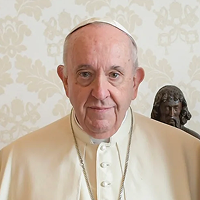
Religious Leader
Pope Francis
Dec 17, 1936 - Apr 21, 2025
We must not focus on occupying the spaces where power is exercised, but rather on starting long-run historical processes. We must initiate processes rather than occupy spaces.

It is remarkable how weak international political responses have been. The failure of global summits on the environment make it plain that our politics are subject to technology and finance.
The unjust distribution of goods persists, creating a situation of social sin that cries out to Heaven and limits the possibilities of a fuller life for so many of our brothers.
The ideology of Marxism is wrong. But I have met many Marxists in my life who are good people, so I don't feel offended. ... The promise was that when the glass was full, it would overflow, benefiting the poor. But what happens instead, is that when the glass is full, it magically gets bigger (and) nothing ever comes out for the poor.
Just as the commandment "Thou shalt not kill" sets a clear limit in order to safeguard the value of human life, today we also have to say "thou shalt not" to an economy of exclusion and inequality. Such an economy kills. How can it be that it is not a news item when an elderly homeless person dies of exposure, but it is news when the stock market loses two points? This is a case of exclusion.
While the earnings of a minority are growing exponentially, so too is the gap separating the majority from the prosperity enjoyed by those happy few. This imbalance is the result of ideologies which defend the absolute autonomy of the marketplace and financial speculation. Consequently, they reject the right of states, charged with vigilance for the common good, to exercise any form of control.
A new tyranny is thus born, invisible and often virtual, which unilaterally and relentlessly imposes its own laws and rules. Debt and the accumulation of interest also make it difficult for countries to realize the potential of their own economies and keep citizens from enjoying their real purchasing power. To all this we can add widespread corruption and self-serving tax evasion, which have taken on worldwide dimensions.
The thirst for power and possessions knows no limits. In this system, which tends to devour everything which stands in the way of increased profits, whatever is fragile, like the environment, is defenseless before the interests of a deified market, which become the only rule.
Today, as the Church seeks to experience a profound missionary renewal, there is a kind of preaching which falls to each of us as a daily responsibility. It has to do with bringing the Gospel to the people we meet, whether they be our neighbours or complete strangers. This is the informal preaching which takes place in the middle of a conversation, something along the lines of what a missionary does when visiting a home.
Being a disciple means being constantly ready to bring the love of Jesus to others, and this can happen unexpectedly and in any place: on the street, in a city square, during work, on a journey.
In this preaching, which is always respectful and gentle, the first step is personal dialogue, when the other person speaks and shares his or her joys, hopes and concerns for loved ones, or so many other heartfelt needs. Only afterwards is it possible to bring up God's word, perhaps by reading a Bible verse or relating a story, but always keeping in mind the fundamental message: the personal love of God who became man, who gave himself up for us, who is living and who offers us his salvation and his friendship.
Among the vulnerable for whom the Church wishes to care with particular love and concern are unborn children, the most defenceless and innocent among us. Nowadays efforts are made to deny them their human dignity and to do with them whatever one pleases, taking their lives and passing laws preventing anyone from standing in the way of this. Frequently, as a way of ridiculing the Church's effort to defend their lives, attempts are made to present her position as ideological, obscurantist and conservative.
Yet this defence of unborn life is closely linked to the defence of each and every other human right. It involves the conviction that a human being is always sacred and inviolable, in any situation and at every stage of development. Human beings are ends in themselves and never a means of resolving other problems.
In order to sustain dialogue with Islam, suitable training is essential for all involved, not only so that they can be solidly and joyfully grounded in their own identity, but so that they can also acknowledge the values of others, appreciate the concerns underlying their demands and shed light on shared beliefs. We Christians should embrace with affection and respect Muslim immigrants to our countries in the same way that we hope and ask to be received and respected in countries of Islamic tradition.
A healthy pluralism, one which genuinely respects differences and values them as such, does not entail privatizing religions in an attempt to reduce them to the quiet obscurity of the individual's conscience or to relegate them to the enclosed precincts of churches, synagogues or mosques.
Christ's resurrection is not an event of the past; it contains a vital power which has permeated this world. Where all seems to be dead, signs of the resurrection suddenly spring up. It is an irresistible force.
Children have the right to grow up in a family with a father and mother capable of creating a suitable environment for the child's development and emotional maturity. Today marriage and the family are in crisis. We now live in a culture of the temporary, in which more and more people are simply giving up on marriage as a public commitment.
The revolution in mores and morals has often flown the flag of freedom, but in fact it has brought spiritual and material devastation to countless human beings, especially the poorest and most vulnerable.
The human heart desires joy. We all desire joy, every family, every people aspires to happiness. But what is the joy that the Christian is called to live out and bear witness to? It is the joy that comes from the closeness of God, from his presence in our life. From the moment Jesus entered into history, with his birth in Bethlehem, humanity received the seed of the Kingdom of God, like the soil receives the seed, the promise of a future harvest.
Dear brothers and sisters, I have often thought of how the Church may render more clear her mission to be a witness to mercy; and we have to make this journey. It is a journey which begins with spiritual conversion. Therefore, I have decided to announce an Extraordinary Jubilee which has at its centre the mercy of God. It will be a Holy Year of Mercy.
Popular Authors


