
Quotes By Pope Francis
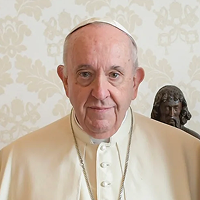
Religious Leader
Pope Francis
Dec 17, 1936 - Apr 21, 2025
Narcissism makes people incapable of looking beyond themselves, beyond their own desires and needs.

Finally an evangelizing community is filled with joy; it knows how to rejoice always.
The act of deporting people who in many cases have left their own land for reasons of extreme poverty, insecurity, exploitation, persecution or serious deterioration of the environment, damages the dignity of many men and women, and of entire families, and places them in a state of particular vulnerability and defenselessness.
Time, my brothers and sisters, seems to be running out; we are not yet tearing one another apart, but we are tearing apart our common home. Today, the scientific community realizes what the poor have long told us: harm, perhaps irreversible harm, is being done to the ecosystem. The earth, entire peoples and individual persons are being brutally punished.
The urgent task of proclaiming the Gospel in our time demands that believers, and priests in particular, ensure that everyone be able to encounter Jesus Christ made flesh, made man, made history.We must always take care never to lose sight of the "flesh" of Jesus Christ: that flesh made of passions, emotions and feelings, words that challenge and console, hands that touch and heal, looks that liberate and encourage, flesh made of hospitality, forgiveness, indignation, courage, fearlessness; in a word, love.
The culture of comfort, which makes us think only of ourselves, makes us insensitive to the cries of other people, makes us live in soap bubbles which, however lovely, are insubstantial; they offer a fleeting and empty illusion that results in indifference to others; indeed, it even leads to the globalization of indifference.
Each year sees the disappearance of thousands of plant and animal species which we will never know, which our children will never see, because they have been lost for ever. The great majority become extinct for reasons related to human activity. Because of us, thousands of species will no longer give glory to God by their very existence, nor convey their message to us. We have no such right.
This is the way human beings contrive to feed their self-destructive vices: trying not to see them, trying not to acknowledge them, delaying the important decisions and pretending that nothing will happen.
It cannot be maintained that empirical science provides a complete explanation of life, the interplay of all creatures and the whole of reality.
We gorged ourselves on networking, and lost the taste of fraternity.
It is striking that even some who clearly have solid doctrinal and spiritual convictions frequently fall into a lifestyle which leads to an attachment to financial security, or to a desire for power or human glory at all cost, rather than giving their lives to others in mission.
The people itself constitutes a subject. And the church is the people of God on the journey through history, with joys and sorrows. Thinking with the church, therefore, is my way of being a part of this people. And all the faithful, considered as a whole, are infallible in matters of belief, and the people display this infallibilitas in credendo, this infallibility in believing, through a supernatural sense of the faith of all the people walking together.
To serve means to work alongside the neediest, first of all to establish a close human relationship with them, based on solidarity. Solidarity-this word elicits fear in the developed world. They try not to say it. It is almost a dirty word for them. But it's our word!
Many young people are taken in by ideologies, used and exploited as cannon fodder or a strike force to destroy, terrify or ridicule others. Worse yet, many of them end up as individualists, hostile and distrustful of others; in this way, they become an easy target for the brutal and destructive strategies of political groups or economic powers.
The majority of people living on our planet profess to be believers. This should spur religions to dialogue among themselves for the sake of protecting nature, defending the poor, and building networks of respect and fraternity.
The Church is a mother, and her motherly attention is expressed with special tenderness and closeness to those who are obliged to flee their own country and exist between rootlessness and integration.
There can be no renewal of our relationship with nature without a renewal of humanity itself.
On the lips of the catechist the first proclamation must ring out over and over: "Jesus Christ loves you; he gave his life to save you; and now he is living at your side every day to enlighten, strengthen and free you.
As long as the problems of the poor are not radically resolved by rejecting the absolute autonomy of markets and financial speculation and by attacking the structural causes of inequality, no solution will be found for the world's problems or, for that matter, to any problems. We can no longer trust in the unseen forces and the invisible hand of the market.
Hostility, extremism and violence are not born of a religious heart: they are betrayals of religion. We believers cannot be silent when terrorism abuses religion; indeed, we are called unambiguously to dispel all misunderstandings.
Popular Authors


