
Quotes By Mao Zedong
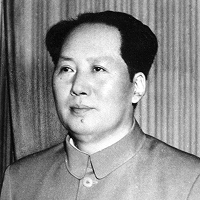
Politician
Mao Zedong
Dec 26, 1893 - Sep 09, 1976
The contest of strength is not only a contest of military and economic power, but also a contest of human power and morale. Military and economic power is necessarily wielded by people.

The commanders and fighters of the entire Chinese People's Liberation Army absolutely must not relax in the least their will to fight; any thinking that relaxes the will to fight and belittles the enemy is wrong.
Whoever sides with the revolutionary people is a revolutionary. Whoever sides with imperialism, feudalism and bureaucrat-capitalism is a counter-revolutionary. Whomever sides with the revolutionary people in words only but acts otherwise is a revolutionary in speech. Whoever sides with the revolutionary people in deed as well as in word is a revolutionary in the full sense.
As for the imperialist countries, we should unite with their peoples and strive to coexist peacefully with those countries, do business with them and prevent any possible war, but under no circumstances should we harbour any unrealistic notions about them.
Those experienced in work must take up the study of theory and must read seriously; only then will they be able to systematize and synthesize their experience and raise it to the level of theory, only then will they not mistake their partial experience for universal truth and not commit empiricist errors.
The imperialists and domestic reactionaries will certainly not take their defeat lying down and they will struggle to the last ditch. After there is peace and order throughout the country, they will still engage in sabotage and create disturbances in various ways and will try every day and every minute to stage a comeback. This is inevitable, beyond all doubt, and under no circumstances must we relax our vigilance.
Soldiers are the foundation of an army; unless they are imbued with a progressive political spirit, and unless such a spirit is fostered through progressive political work, it will be impossible to achieve genuine unity between officers and men, impossible to arouse their enthusiasm for the War of Resistance to the full, and impossible to provide an excellent basis for the most effective use of all our technical equipment and tactics.
We Communists must be able to integrate ourselves with the masses in all things. If our Party members spend their whole lives sitting indoors and never go out to face the world and brave the storm, what good will they be to the Chinese people? None at all, and we do not need such people as Party members. We Communists ought to face the world and brave the storm the great world of mass struggle and the mighty storm of mass struggle.
Communists should set an example in being practical as well as far-sighted. For only by being practical can they fulfil the appointed tasks, and only far-sightedness can prevent them from losing their bearings in the march forward.
We stand for self-reliance. We hope for foreign aid but cannot be dependent on it; we depend on our own efforts, on the creative power of the whole army and the entire people.
New things always have to experience difficulties and setbacks as they grow. It is sheer fantasy to imagine that the cause of socialism is all plain sailing and easy success, without difficulties and setbacks or the exertion of tremendous efforts.
Liberalism is extremely harmful in a revolutionary collective. It is a corrosive which eats away unity, undermines cohesion, causes apathy and creates dissension. It robs the revolutionary ranks of compact organization and strict discipline, prevents policies from being carried through and alienates the Party organizations from the masses which the Party leads. It is an extremely bad tendency.
War is the highest form of struggle for resolving contradictions, when they have developed to a certain stage, between classes, nations, states, or political groups, and it has existed ever since the emergence of private property and of classes.
The masses are the real heroes, while we ourselves are often childish and ignorant, and without this understanding, it is impossible to acquire even the most rudimentary knowledge.
Every difference in human concepts should be seen as a reflection of objective contradictions. These objective contradictions are reflected in subjective thought, forming the contradictory movement of concepts, driving the development of thought, and continuously resolving people's ideological problems.
Stalin made mistakes. He made mistakes towards us, for example, in 1927. He made mistakes towards the Yugoslavs too. One cannot advance without mistakes. It is necessary to make mistakes. The party cannot be educated without learning from mistakes. This has great significance.
Popular Authors


