
Quotes By Jawaharlal Nehru
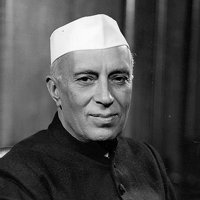
Leader
Jawaharlal Nehru
Nov 14, 1889 - May 27, 1964
What the mysterious is I do not know. I do not call it God because God has come to mean much that I do not believe in. I find myself incapable of thinking of a deity or of any unknown supreme power in anthropomorphic terms, and the fact that many people think so is continually a source of surprise to me. Any idea of a personal God seems very odd to me.

If any person raises his hand to strike down another on the ground of religion, I shall fight him till the last breath of my life, both as the head of the government and from the outside.
The Bhagavad Gita deals essentially with the spiritual foundation of human existence. It is a call of action to meet the obligations and duties of life; yet keeping in view the spiritual nature and grander purpose of the universe.
It is dangerous and harmful to be guided in our life's course by hatreds and aversions, for they are wasteful of energy and limit and twist the mind and prevent it from perceiving the truth.
Blood and tears are going to be our lot, whether we like them or not. Our blood and tears will flow; maybe the parched soil of India needs them so that the fine flower of freedom may grow again.
All the nations and peoples are too closely knit together today for any one of them to imagine that it can live apart. Peace has been said to be indivisible, so is freedom, so is prosperity now, and so also is disaster in this one world that can no longer be split into isolated fragments.
The spectacle of what is called religion, or at any rate organised religion, in India and elsewhere, has filled me with horror and I have frequently condemned it and wished to make a clean sweep of it. Almost always it seemed to stand for blind belief and reaction, dogma and bigotry, superstition, exploitation and the preservation of vested interests.
Often in history we see that religion, which was meant to raise us and make us better and nobler, has made people behave like beasts. Instead of bringing enlightenment of them, it has often tried to keep them in the dark; instead of broadening their minds, it has frequently made them narrow-minded and intolerant of others.
The light that shone in this country [Gandhi] was no ordinary light... and a thousand years later that light will still be seen in this country and the world will see it... For that light represented the living truth.
Science and technology have freed humanity from many burdens and given us this new perspective and great power. This power can be used for the good of all. If wisdom governs our actions; but if the world is mad or foolish, it can destroy itself just when great advances and triumphs are almost without its grasp.
At the dawn of history, India started on her unending quest, and trackless centuries are filled with her striving and the grandeur of her success and her failures. Through good and ill fortune alike, she has never lost sight of that quest or forgotten the ideals which gave her strength.
To awaken the people, it is the women who must first be awakened. Once she is on the move, the family moves, the village moves, the nation moves.
Fine buildings, fine pictures and books and everything that is beautiful are certainly signs of civilization. But an even better sign is a fine man who is unselfish and works with others for the good of all. To work together is better than to work singly, and to work together for the common good is best of all.
We have a great deal of evidence to show that the R.S.S. is an organization which is in the nature of a private army and which is definitely proceeding on strictest Nazi lines, even following the technique of organization. The Nazi party brought Germany to ruin and I have little doubt that if these tendencies are allowed to spread and increase in India, they would do enormous injury to India.
The discovery of India - what have I discovered? It was presumptuous of me to imagine that I could unveil her and find out what she is today and what she was in the long past. Today she is four hundred million separate individual men and women, each differing from the other, each living in a private universe of thought and feeling. If this is so in the present, how much more so to grasp that multitudinous past of innumerable successions of human beings.
India is a geographical and economic entity, a cultural unity amidst diversity, a bundle of contradictions held together by strong but invisible threads. Overwhelmed again and again her spirit was never conquered, and today when she appears to be a plaything of a proud conqueror, she remains unsubdued and unconquered.
About her [India], there is the elusive quality of a legend of long ago; some enchantment seems to have held her mind. She is a myth and an idea, a dream and a vision, and yet very real and present and pervasive.
The world of today has achieved much, but for all its declared love for humanity, it has based itself far more on hatred and violence than on the virtues that make one human. War is the negation of truth and humanity. War may be unavoidable sometimes, but its progeny are terrible to contemplate. Not mere killing, for man must die, but the deliberate and persistent propagation of hatred and falsehood, which gradually become the normal habits of the people.
A study of Marx and Lenin produced a powerful effect on my mind and helped me to see history and current affairs in a new light. The long chain of history and of social development appeared to have some meaning, some sequence and the future lost some of its obscurity. The practical achievements of the Soviet Union were also tremendously impressive. Often I disliked or did not understand some development there and it seemed to me to be too closely concerned with the opportunism of the moment or the power politics of the day.
A mad man has put an end to his life, for I can only call him mad who did it, and yet there has been enough of poison spread in this country during the past years and months and this poison has had effect on people's minds. We must face this poison. We must root out this poison and we must face all the perils that encompass us and face them not madly or badly but rather in the way that our beloved teacher [Gandhi] taught us to face them.
Popular Authors


